A lot of the discussion about AI and automation starts with the easiest benefit to measure: time and cost. But the bigger benefits can be harder to put into a spreadsheet: consistency, better information, faster handoffs and ultimately a business that is less dependent on individual people remembering how everything works.
Getting your house in order
Whenever I talk to a business about their workflows, the first thing that leaps out is the need to stop and think about why a process happens the way it does. This usually leads to at least some opportunities to improve and simplify a process before we even start automating anything.
Reliability
Making a process consistent can have unexpected flow on effects. There are lots of things in business that you want to happen the same way every time, whether it’s a customer experience or something internal, a more reliable process can mean fewer dropped tasks or errors and more predictable responses.
Case study: A business received a high volume of quote requests. Quotes went out, but follow-up was inconsistent. The business introduced an automatic follow-up task whenever a quote was sent: sales reps continued to personally pursue higher-value opportunities, while lower-priority enquiries could enter an automated follow-up path.
Speed
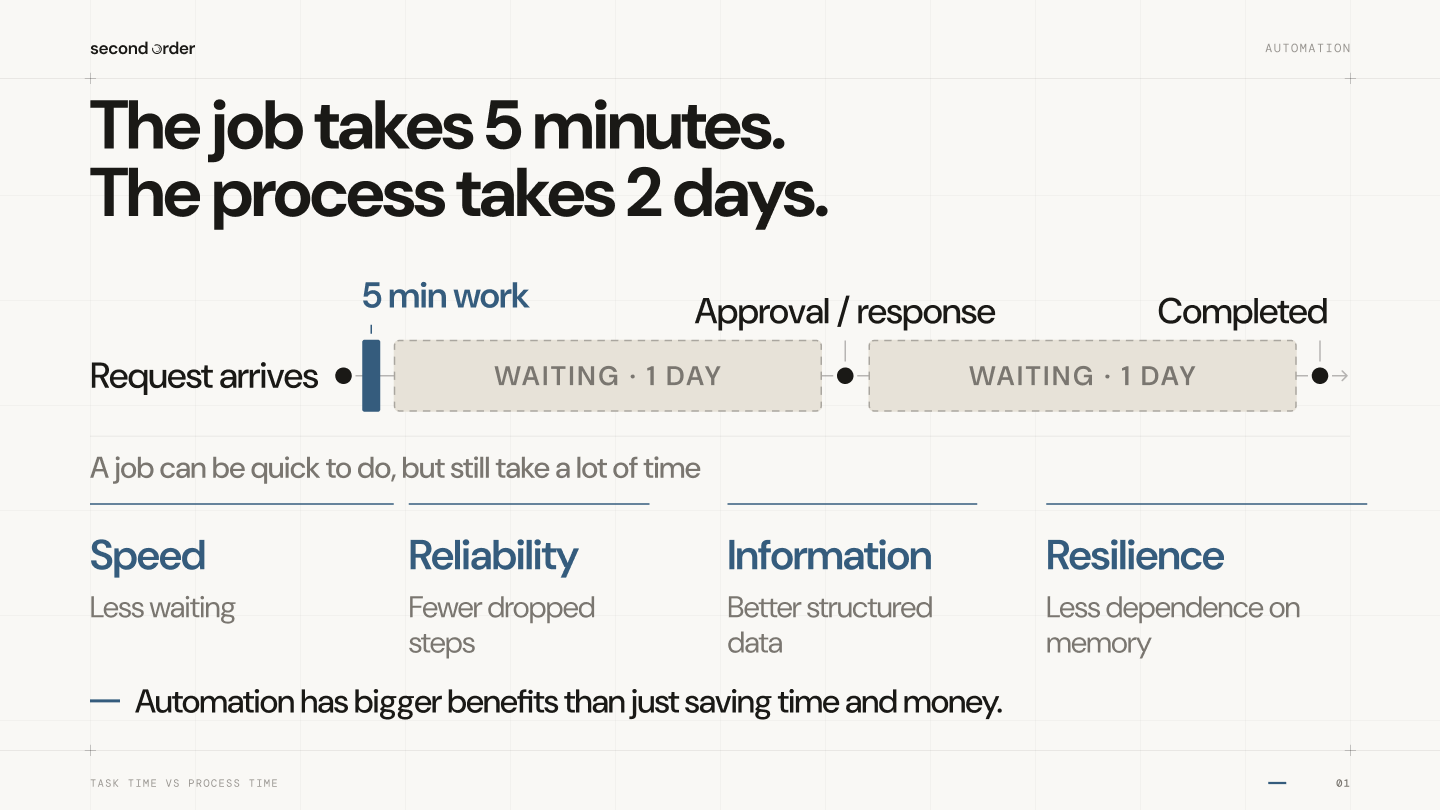
The time taken to actually do a job isn’t the only time factor to consider. Some jobs might be quick in themselves, but might regularly stall while waiting for feedback or the next person to action. Automation can help cut out this waiting time, speeding things up whether for other staff or for customers.
A task may only take five minutes to complete, but if it sits in someone’s inbox for two days before being done, that is where the real saving comes from.
Information quality
Processes create information; such as what products or services customers are most interested in, or waiting times, or close rates, or common objections, etc. Well-designed automation can make it easier to capture this information consistently.
This can improve reporting, giving you a clearer and more up-to-date picture of where things are actually at in the business, ultimately enabling better decisions.
Case study: In the process of automating the quote follow-ups, there was an opportunity to also capture and connect up the data; from source of the query, to product/service requested to quote, to outcome/close rate; all enabling a better understanding of marketing spend and pipeline stages.
Business continuity and resilience
All of these benefits compound; increased reliability, speed, better information, all lead to a more robust and resilient business.
By moving processes and knowledge out of people’s heads and into a reliable system, the whole business becomes less dependent on single individuals or other fragile points of failure.
This doesn’t mean you need to be replacing staff with automation, but it can mean that it’s easier to manage staff turnover/leave, or training and onboarding.
Case study: By automating the quoting process, as well as improving speed, reliability and information quality, the company was able to work out what useful knowledge still sat in employees’ heads, and create a more robust and scalable system for the future.
By making key knowledge more accessible, and the business more consistent, you are making the business more transferable and easier to manage.
The associated risks
Weighing up an automation project goes far beyond the simple time and cost calculations, in fact sometimes it can initially run counter to those instincts, but by understanding these benefits you can keep an automation project heading in the right direction.
At the same time, if you start automating processes without this in mind, there is a risk of creating a series of fragile automations, often relying on one person who knows how they work.
This is why it’s important to approach automation from a strategic perspective, take a step back first and consider the whole business, and make sure everything you do is sensibly documented, and there is monitoring and failure paths in place, so somebody is always able to recover the process if needed.
Commercial outcomes
All of this should eventually show up commercially: faster quotes, better follow-up, fewer missed enquiries, a more consistent customer experience, clearer reporting and less time spent fixing avoidable problems.
But the bigger point is that good automation should leave the business in a stronger state than it found it.
A useful automation solves today’s problem. A well-designed one also leaves behind better information, clearer ownership, more reliable processes and less dependence on individual people.
That is where the real compounding value starts.
Find opportunities in your business
We’ve turned part of our AI & Automation Opportunity Review method into a practical workbook you can use yourself. Start with how the business actually works, then look for friction in workflows, information, handoffs and decisions.